
Science
Scientific discoveries and research

Multiple threats endanger the world's rarest great ape, a new study on the Tapanuli orangutan reveals
Deep in the forests of North Sumatra, Indonesia, lives the Tapanuli orangutan (Pongo tapanuliensis), the world's rarest great ape. Fewer than 800 individuals re...

Fossils from Wyoming's Smiley Draw deepen understanding of early primate evolution
A new study from the University of Kansas complicates the picture of primates living in North America some 55 million years ago during the Eocene, a warm period...

Human norovirus capsid shifts between two shapes, cryo-EM reveals
A research team led by Kazuyoshi Murata has discovered that virus-like particles (VLPs) of human norovirus genotype GII.3 are not structurally rigid, but can ad...

Some speed‑reading apps make big claims. But how fast can humans actually read?
Some speed-reading advocates claim that with proper training (outlined in many popular books and YouTube videos) or the use of special apps, it's possible to in...

Decades-old theory for how insect societies evolve challenged
For more than 60 years, evolutionary biologists have debated whether a unique genetic system found in ants, bees and wasps helps explain one of nature's most re...

First measurement of antineutrinos from spent nuclear fuel confirms emissions persist after reactor shutdown
Even when the lights go out and nuclear reactors are turned off, the story inside the reactor core still has a great deal to tell. Radioactive, long-lived fissi...

Snakes aren't simple tubes. Their bodies have five regions—including a short neck
Snakes are seemingly simple in structure: a head attached to a long, unremarkable noodle. They do have some pretty cool features at the front end, with venomous...

How does social vulnerability evolve after a tropical cyclone?
After tropical cyclones, communities are often left in upheaval. Those that had few resources to begin with tend to be especially vulnerable to external stresse...

Sticky alpine flower confirms Darwin's 150-year-old carnivorous plant prediction
A flowering plant has been confirmed as a new carnivorous lineage, according to research published in Nature Communications. The findings show that Saxifraga ca...
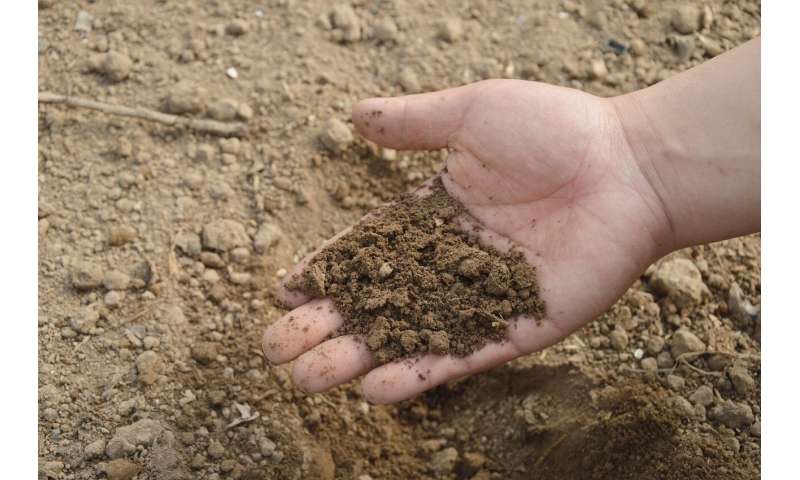
Miscanthus roots reveal deeper soils may retain more stable carbon
Deeply rooted perennial plants may help build soil carbon (C) stocks, but most research has focused on shallow soils, resulting in gaps in our understanding of...

Why some people are mosquito magnets while others get away unbitten
Some mosquitoes really are picky eaters. They will not just stick their proboscis into any old human. We know this anecdotally, with some people claiming they a...

Mapping the upper atmosphere with public Starlink satellite data
The space around Earth is becoming increasingly crowded, with thousands of satellites and pieces of debris now sharing low Earth orbit. Even above this region—a...